
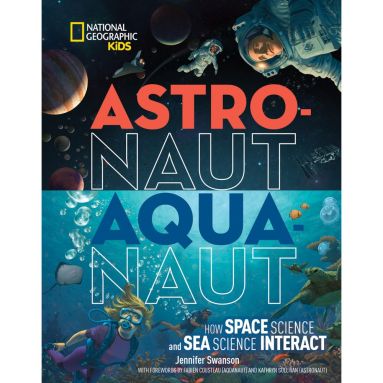
 Astronauts and aquanauts are two career paths which on the surface go in opposite directions. Which one would you choose? The number one answer I hear from MG girls is Marine Biologist. For boys it’s often an astronaut but only if their first wish isn’t realized: to be a pro basketball player.
This new title from the creative minds at National Geographic Kids (author Jennifer Swanson in this case), explores how these two exciting endeavors are more alike than similar. Beginning with Exploring New Environments you’ll learn how gravity, pressure, and darkness effect both types of explorers. Next comes a look at the training involved to become one of these brave individuals. Hear from astronauts as to what it’s like to blastoff into space and from aquanauts how it feels to take the plunge deep into the depths of our oceans.
Then you get an insiders view of the experience living in these environments, including the work done to survive. A fascinating page is devoted to a typical day in space and sea. I’m not sure I’d be up for the task in either of the temporary homes.
Bringing the journey to a satisfying ending (or hopefully a beginning for young readers) are chapters on why we explore and what we have learned so far. I especially enjoyed the biographies of ten real life astronauts and aquanauts. Middle grade kids just might follow one of their paths to greatness.
Here’s the official word from National Geographic Kids:
Journey from the deepest trenches in the oceans to the farthest humans have ventured into space and learn what it takes to explore the extremes. You might just be surprised by how similar the domains of ASTRONAUTS and AQUANAUTS really are.
Space and the ocean. If you don’t think they go together, think again! Both deep-sea and space explorers have to worry about pressure, temperature, climate, and most importantly, how to survive in a remote and hostile environment. Join us on an amazing journey as we go up in space with astronauts and dive deep down in the ocean with aquanauts to explore the far-off places of our planet and the solar system.
With a strong tie into STEM topics–such as making connections, making comparisons, and recognizing patterns across content areas–readers will discover the amazing science and incredible innovations that allow humans (and sometimes only machines) to survive in these harsh environments.
Amazing pictures also accompany the text. Inspiring and thought provoking, this title should be a library favorite for many years to come.
*********************************


 has a knack for solving the unknown. It’s told in third person and begins in 1963 then flashes forward to present day.
 FIVE THINGS TO LIKE ABOUT: THE LAKE OF FIRE
 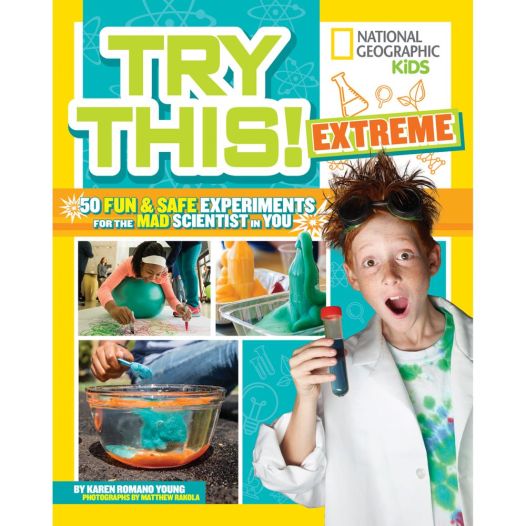 Science lovers beware. You are going to have a blast with this book. Filled with 50 experiments you can try out at home or school, be prepared to learn in a fun hands-on way.

 10-year-old Annie uses cuss words in her thoughts and sometimes out loud with her friends. Damn, hell and crap are her favorites, though she sneaks in a few stronger ones. It’s not excessive, maybe a dozen occurrences. A Catholic upbringing has her assigning Hail Mary penance after using an offensive word.
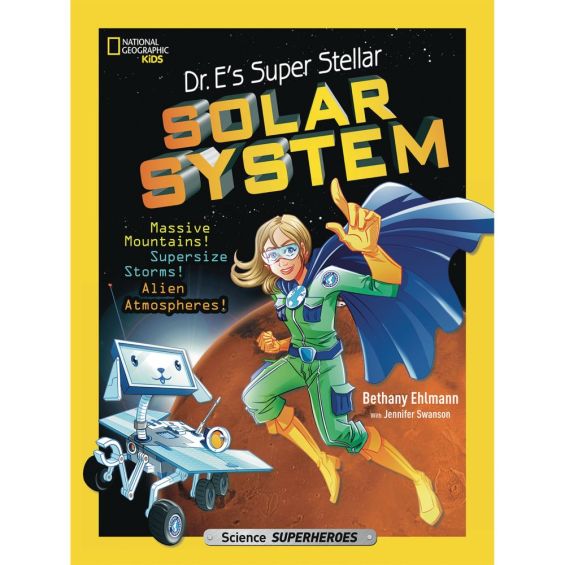 Whether you know a lot or a little about our solar system, this new title is sure to send you into an orbit of adventure and learning. Author Dr. Bethany Ehlmann changes into her alter superhero disguise, Dr. E, to present fascinating facts and journeys about the world beyond. Each of the ten chapters begin with a paneled cartoon where Dr. E and her six-wheel sidekick, Rover, prepare readers for what lies ahead.



 This just in from the New Mexico Department of Tourism:



 Always in the Middle...