I’m pleased to start the year off with Gregory Funaro. His first book for Disney-Hyperion, ALISTAIR GRIM’S ODDITORIUM (2015), was a New York Times best seller and an Amazon Best Book of the Month, and his second, ALISTAIR GRIM’S ODD AQUATICUM (2016), received a Kirkus STARRED review. His newest is WATCH HOLLOW. Look for my review next week on our first MARVELOUS MIDDLE GRADE MONDAY of 2019
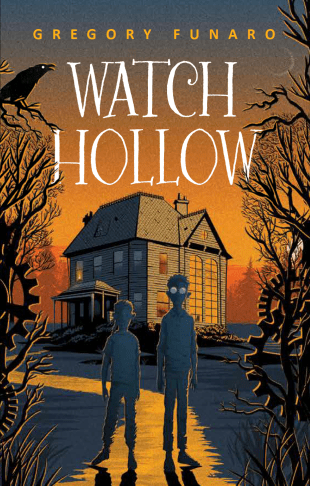
Deep within the enchanted woods in the town of Watch Hollow stands the once-grand Blackford House, whose halls hold a magical secret: a giant cuckoo clock that does much more than tell time. But when the clock’s gears cease to turn, an evil presence lurking among the trees begins to come out of the shadows.
When Lucy and Oliver Tinker arrive in Watch Hollow, they have no idea that anything is wrong. A mysterious stranger has made their father an offer that’s too good for him to refuse. All Mr. Tinker needs to do is fix the clock at Blackford House and fistfuls of gold coins are his to keep.
It doesn’t take long, however, for the children to realize that there is more to Blackford House than meets the eye. And before they can entirely understand the strange world they’ve stumbled into, Lucy and Oliver must join forces with a host of magical clock animals to defeat the Garr—a vicious monster that not only wants Blackford House for itself, but also seeks to destroy everything the Tinkers hold dear.
Thanks for joining us this morning, Greg, and welcome to ALWAYS in the MIDDLE. Take us through how the story and series came to be. Did the characters or plot come first?
I was approached with an in-house proposal by Abby Ranger when she was a senior editor at HarperCollins. The final story ended up being much different than that original proposal, but as many of the characters and elements remained in some form or another (the sentient house, the wooden animals, the creeping woods and its monster), the characters definitely came first and the plot evolved around them. That’s usually how I write anyway: I have a vague idea of plot and sort of throw the characters into it and see where they take me. In any event, the biggest difference from the original proposal was the giant cuckoo clock and, consequently, Mr. Tinker being a widower who is hired to fix it. David Linker, another senior editor at HarperCollins, helped me develop the final story. He is awesome.
Your ODDITORIUM series didn’t use a prologue introduction, but you included one for WATCH HOLLOW (and it’s a very enticing page and half, too!) When is a prologue necessary and when is it better to just jump into the first scene?
I love prologues! Not only do they set the tone and whet the reader’s appetite for what’s to come, but a prologue can also offer a window into the plot from the point of view of a character around whom the main narrative isn’t structured. They also allow the reader to enter the story at a high point of action, after which there is time to slow down and get to know the characters a little more before picking up the action again. I tried something different with the Odditorium books and used the newspaper articles to this effect. So, in short, I find prologues indispensable.
Is an attention-grabbing beginning or a satisfying ending harder to write?
Endings are harder, I think. I usually have a good idea how to begin a story, whether it’s a scene or even just an image. But an ending is much more difficult–more delicate, I should say–and requires a certain finesse and economy of language (dare I say poetry?) so that it lands the way you want. The best endings leave the reader satisfied but also sorry the story is over. So yeah, endings are tough.
What books inspired you to become a writer?
I’ve been reading Stephen King since the fifth grade, so even though I wasn’t aware of it at the time, books like Carrie and Salem’s Lot probably set me off on the path to becoming a writer.
Where do you get your ideas for stories?
Usually I’ll see or hear something, maybe even a piece of music, and an image will pop into my head and I’ll wonder, “What would happen if…” I’ve never written anything by first sitting down and saying to myself, “What shall I write about?” For instance, the idea for my first novel (which was never published) came from a story my dad told me about how his grandmother used to talk to spirits with a little white baby boot that hung from a pair of scissors. It’s sort of complicated, but suffice it to say, I built an entire story around that little white boot.
Writing can be a solitary journey. Who is on your support team that keeps you moving forward?
My agent, Bill Contardi, is always there to listen and look out for me, so I don’t know what I’d do without him. I’ve also been really fortunate to have wonderful editors throughout my career, a family and a group of friends who support what I do, and a handful of readers who will give me honest feedback. And, of course, there is always MC.
Are there any special events for the launch of WATCH HOLLOW?
Once I am through the Christmas holiday, I will try to set up some giveaways and a contest or two. Maybe there will be some book signings, I’m not sure, but I’ll keep everyone posted on Twitter and via my web site.
What can readers look forward to with the next book in the series?
Some unexpected guests arrive at Blackford House, and a new terror is unleashed–this time from within.
Thank you, Gregory! Have a great year with your new book!
#####################
Here’s what else I’m reading this month:
2018’s CYBILS MIDDLE GRADE FICTION FINALISTS!
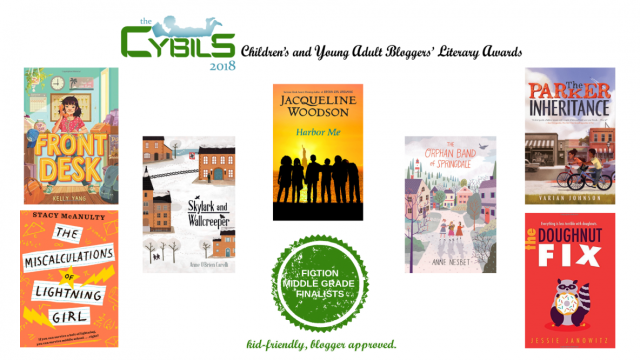
Myself and four other bloggers will announce our top choice on February 14th!
#####################
Coming up this Monday is 2019’s first edition of…

 The big name award groups recognize their favorite books, but my Golden Cup Awards look within the stories to find the best in fifteen unique categories.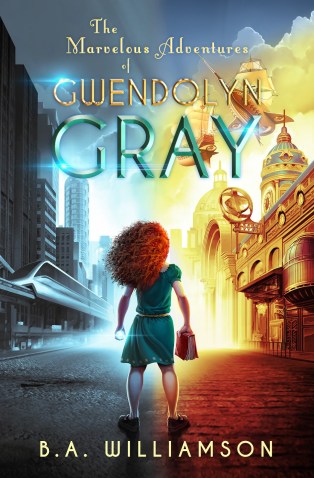
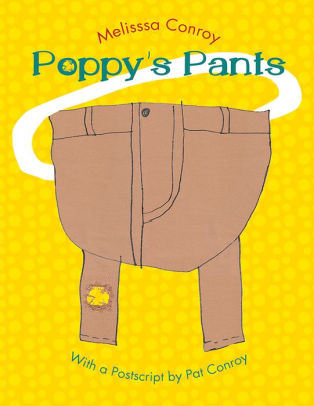 asks Penelope to patch it. Penelope likes to sew, but she soon realizes that mending the hole is more complicated than she first thought. Penelope struggles with the challenges and frustrations, but, with a little help from her mama, she finally—and creatively—repairs Poppy’s pants.
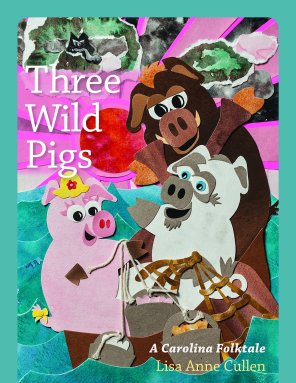 Three Wild Pigs: A Carolina Folktale, written and illustrated by Lisa Anne Cullen, is an adaptation of James Orchard Halliwell-Phillipps’s The Story of the Three Little Pigs. Set on Bird Island along the Carolina Coast, this creative retelling of the timeless tale features three generations of a pig family―Lulu, her father, and her grandfather.

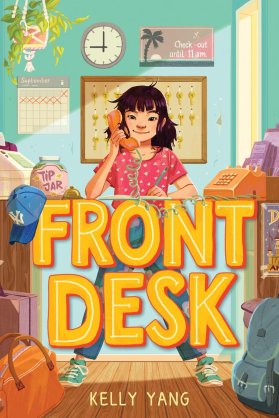 and never giving up also grace the pages. It reaffirms the belief there’s always someone who will help in time of need.
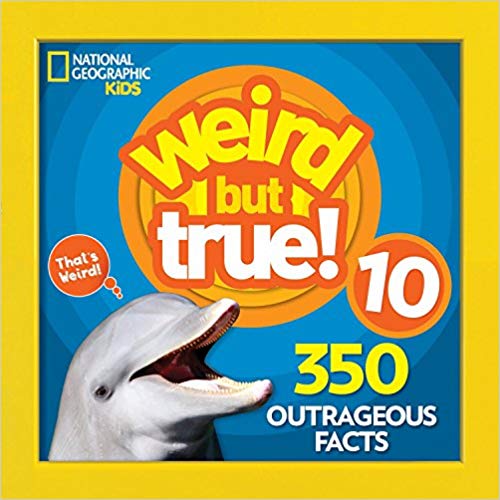





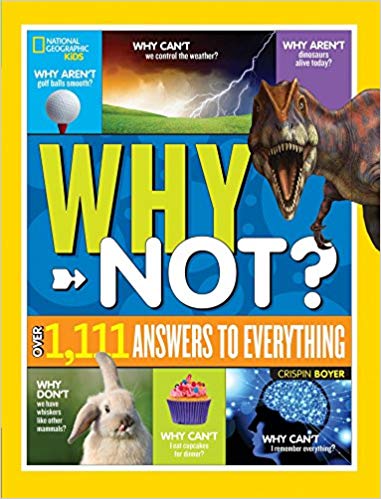 ries: ANIMALS, OUR PLANET, THE UNIVERSE, HISTORY, YOUR BODY, TECHNOLOGY, and POP CULTURE. More than ninety starting questions get the ball rolling and within each two-page spread hundreds more are answered. Colorful backgrounds and images add to the I didn’t know that feeling you’ll get.


 Always in the Middle...